


Can you Use Laser Cutting on Porcelain Tiles? The Honest Answer.


When clients ask about precision cutting for porcelain tiles, the same keywords keep coming up in our conversations - steel cutting services, water jet metal cutting, and metal cutting shops. And they always follow with the same question: "Can you just use a laser?" The honest answer? It's complicated - and this blog will give you the full picture, no fluff, no sales pitch.
What Is Laser Cutting — and How Does It Work on Tiles?
Laser cutting is a thermal, non-contact process that uses a focused beam of light to melt, vaporise, or remove material. It's widely celebrated for its speed, precision, and versatility across metals, plastics, and composites.
When it comes to porcelain tiles, lasers can interact with the material - but "can" and "should" are two very different things. CO2 lasers (wavelength: 10,600 nm) and Nd:YAG lasers are the most commonly tested on ceramics. Under controlled lab conditions, laser cutting on porcelain tiles is technically achievable. However, in real-world applications, the results vary dramatically depending on tile thickness, glaze type, and laser parameters.
The Ceramic Tile Laser Cutting Machine Market was valued at USD 0.42 billion in 2022 and is projected to reach USD 0.81 billion by 2030, growing at a CAGR of 9.1% - a clear sign the industry is investing in making this technology more viable. But that growth reflects ongoing R&D, not a solved problem.
Why Laser Cutting on Porcelain Tiles Is Tricky
Here's the honest part most vendors won't tell you.
Porcelain is an extremely dense, low-porosity material. Its hardness — the very quality that makes it desirable for flooring and wall applications — also makes it resistant to laser energy. The thermal load created during laser cutting can cause:
Micro-cracking along cut edges
Chipping and splintering, especially at corners
Heat-affected zones (HAZ) that alter the tile's structural integrity
Uneven edges requiring post-processing (sanding, grinding)
Underwater CO2 laser cutting has been explored specifically to reduce thermal damage — the water acts as a cooling medium. But this adds process complexity and cost, making it impractical for most commercial applications.
Tiles below 1.5mm thick can be laser-cut with reasonable accuracy (±0.05mm), but standard floor tiles (typically 8–12mm thick) are a much greater challenge. Research into multi-pass cutting and different shield gases has helped, but no single laser method has cracked the code for thick porcelain tiles at commercial scale.
How Water Jet Metal Cutting Solves What Laser Cannot
This is where water jet metal cutting enters the picture - and why it's the preferred choice at leading metal cutting shops for hard, brittle materials like porcelain.
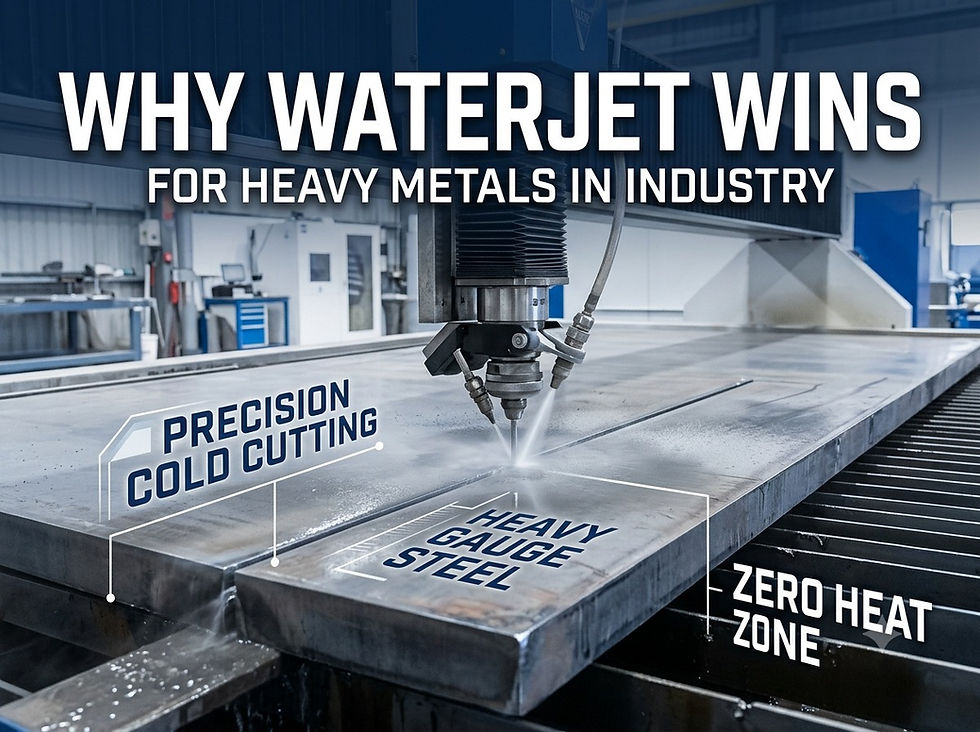
Water jet cutting uses a high-pressure stream of water (often mixed with abrasive garnet) to slice through material with zero heat. That means:
No thermal damage - zero risk of cracking or HAZ Clean, smooth edges - minimal post processing required Handles thickness up to 25mm comfortably Accuracy of ±1.0mm for standard ceramic tiles Works on virtually any material — porcelain, stone, glass, metal
For precision work requiring intricate shapes, logos, or custom patterns in porcelain tiles, water jet cutting consistently outperforms laser cutting in both quality and reliability.
What Our Steel Cutting Services Bring to the Table
Our steel cutting services are built for precision, speed, and results that speak for themselves. Whether it's intricate architectural metalwork, industrial components, or decorative tile inlays, our team combines advanced water jet and laser technology to match the right method to every material.
Here's what sets us apart:
Multi-material expertise — from steel and aluminium to porcelain and stone
In-house design support — we work from your CAD files or help you build them
Fast turnaround — industrial-grade machines mean no delays
Quality-first approach — every cut is inspected before it leaves our facility
Tips for Getting the Best Results When Cutting Porcelain Tiles
Whether you're working with a cutting specialist or evaluating your own process, keep these professional tips in mind:
1. Know Your Tile Thickness For tiles under 1.5mm, laser cutting is viable. For anything thicker, a water jet is the safer, higher-quality option.
2. Always Request a Test Cut Before committing to a full production run, ask your cutting shop to do a sample cut. This reveals edge quality, cracking risk, and finish before you spend the budget.
3. Design Internal Corners Carefully When cutting holes or slots in porcelain, ensure internal corners have a radius at least equal to the tile thickness. Sharp internal corners dramatically increase cracking risk.
4. Choose the Right Cutting Partner Not all metal cutting shops have experience with ceramic and porcelain. Ask specifically about their track record with non-metal materials before you commit.
5. Factor in Post-Processing Even with water jet, some edge finishing may be required for premium installations. Build this into your timeline and budget.
What Our Clients Say
"We came to them with a challenging custom tile inlay project — tight dimensions, intricate geometry. Their water jet cutting was flawless. The edges were so clean we barely needed any finishing. We've used other metal cutting shops before, but none came close to this level of service." — Arjun M., Interior Design Firm, Mumbai
"Honestly, I'd been told laser cutting would work fine on our porcelain feature wall tiles. It didn't. Micro-cracks ruined two batches. Switching to their water jet metal cutting service saved the project — and our deadline." — Priya S., Construction Project Manager, Pune
"Their steel cutting services are exceptional — precise, fast, and the team actually explains what method works best for your material. Refreshing honesty in this industry." — Rahul D., Architect, Delhi
The Verdict: Laser Cutting on Porcelain -Possible, But Not Always Practical
To summarise the honest answer:
Laser cutting on porcelain tiles is technically possible under specific conditions — thin tiles, controlled environments, and the right laser parameters. But for the vast majority of real-world applications involving standard porcelain floor or wall tiles, it introduces more risk than reward.
Water jet cutting is the gold standard for porcelain and ceramic tile work. It's cleaner, safer, more consistent, and delivers premium results without thermal damage.
If you're looking for a partner that combines world-class steel cutting services, expert water jet metal cutting, and the honest advice that too many metal cutting shops skip — you've found us.
Ready to get a precision cut quote? Contact our team today and let's find the right solution for your project at MTM Waterjet & Laser Cutting Services in Sydney


Comments