


7 Common File Mistakes That Delay Your Job (And How to Fix Them Fast)

If you've ever sent a cutting file to a workshop and then received an email asking for revisions, you're definitely not the only one. At MTM Laser & Waterjet Cutting, we regularly see small file issues that can delay a job, increase setup time, and sometimes even lead to material waste. At MTM Laser & Waterjet Cutting in Seven Hills, Sydney, we see the same file errors come through the door week after week. Whether you're getting metal laser cutting Sydney done for the first time or you've been ordering CNC cutting Sydney jobs for years, these mistakes slow your turnaround, inflate your cost, and frustrate both sides.
This post breaks down the 7 most common file mistakes, why they happen, what they cost you, and exactly how to fix them before you hit send.
From our experience, most production delays aren't caused by machine issues or material shortages — they're caused by avoidable file problems. A few minutes spent checking your artwork before sending it can save days of back-and-forth later.
Mistake #1: Sending a Raster File Instead of a Vector File — Why This Kills Precision
This is the number one reason jobs get sent back. A JPEG, PNG, or even a PDF exported from a photo editor is a raster file — it's made of pixels, not mathematical paths. A CNC machining Sydney or laser cutting Sydney machine reads vectors. It needs to follow a path, not guess where the edge of a pixel is.
What to send instead:
.DXF — the gold standard for laser and waterjet machines
.AI or .SVG — acceptable from Illustrator or Inkscape
.PDF with vector paths — only if exported correctly from CAD
Need help converting? Adobe's free vector conversion guide is a solid starting point.
Mistake #2: Getting the Scale Wrong — How One Missing Unit Wastes an Entire Sheet
Your file looks perfect on screen. But nobody told the file it's supposed to be in millimetres. We've seen 300mm panels come through as 300 inches. We've seen intricate gasket designs scaled to postage stamp size.
Before exporting your file, make sure your document units are set to millimetres. It's a simple step, but it prevents some of the most expensive scaling mistakes we see. Add a known reference dimension — a 100mm reference line somewhere in the file. That one step alone eliminates the most expensive scaling mistakes.
"We sent through a DXF for a stainless steel panel and MTM called us within the hour — they spotted a scaling issue before even touching the machine. Saved us a full sheet of material and two days of waiting." — James R., Commercial Fitout Contractor, Parramatta
Mistake #3: Open Paths and Unclosed Shapes — What Your Machine Actually Sees
A shape that looks closed on your screen might have a 0.01mm gap in the path. That's invisible to the human eye but a cutting machine reads it as an open path — and either stops, skips it, or cuts a line straight across your material.
How to check before you send:
In Illustrator: Object > Path > Join to close open paths
In AutoCAD / CAD software: Run AUDIT and OVERKILL commands
In Inkscape: Extensions > Generate from Path > Interpolate
This is especially critical for waterjet cutting Sydney jobs on stone or tile where a machine stop mid-cut means a wasted slab.
Mistake #4: Line Weight That Means Nothing to a Machine — Tips for Clean Cut Lines
Designers set line weights for visual presentation. Laser cutting Sydney and CNC machining Sydney machines don't care how thick your stroke is on screen — they follow the centre of the path. A 5pt stroke on a tight corner is not 5pt of material removed. It's a path with a thick visual representation, and the actual cut line may be nowhere near where you intended.
The fix:
Use hairline strokes (0.001pt) for all cut lines
Separate cut lines, engrave lines, and score lines by colour or layer
Label layers clearly: CUT, SCORE, ENGRAVE — this speeds up your quote and job setup
Mistake #5: Text Not Converted to Outlines — Why Your Font Won't Travel With Your File
You've set your job title in a clean sans-serif. Looks great on your machine. Your laser cutting Sydney provider opens the file on theirs — and the font substitutes, spacing shifts, letters overlap. If the font isn't embedded or converted, it's gone.
Always convert all text to outlines/paths before exporting. In Illustrator: Select All > Type > Create Outlines. In Inkscape: Select All > Path > Object to Path. No exceptions, regardless of how common the font is.
"MTM picked up that our logo text was still live type in the DXF. They converted it for us, sent a proof, and we had the acrylic panel cut and delivered same week. Genuinely impressive turnaround." — Sarah M., Interior Designer, Surry Hills
Mistake #6: Duplicate Lines and Overlapping Paths — Why Your Cut Time (and Cost) Doubles
Copy-paste workflow in CAD often leaves duplicate lines sitting exactly on top of each other. To the eye, one line. To a CNC cutting Sydney machine, two passes — which means double the cut time, potential burning on thin materials, and a higher quote than you expected.
How to clean up before sending:
AutoCAD: Run the OVERKILL command — it merges and removes duplicates
Illustrator: Object > Path > Clean Up
Inkscape: Edit > Find/Replace duplicates or use the XML editor to audit
For metal laser cutting Sydney jobs with complex geometry, this one fix alone can reduce your cutting time by 20–30%.
Mistake #7: Not Checking Minimum Feature Size — What Waterjet and Laser Can't Cut
Every cutting method has a physical limit. Laser cutting Sydney on 3mm stainless steel can't reliably cut features narrower than 0.8–1mm. Waterjet cutting Sydney on stone can't hold internal corners smaller than the nozzle kerf width. If your design includes features below these thresholds, the machine will either skip them, burn them closed, or produce an unusable result.
Your 60-Second Pre-Send Checklist — Stop the Most Common Delays Before They Start
✅ File format: DXF, AI, or SVG — no JPEGs or PNGs
✅ Units: Millimetres, with a 100mm reference dimension included
✅ Paths: All shapes fully closed, no open paths
✅ Lines: Cut, score, engrave on separate layers, hairline strokes
✅ Text: All converted to outlines/paths
✅ Duplicates: Run OVERKILL or Clean Up before export
✅ Feature size: Nothing below 0.8mm unless confirmed with your provider
Why Sydney Businesses Trust MTM for Laser and Waterjet Cutting
MTM Laser & Waterjet Cutting is based in Seven Hills, Sydney, servicing businesses across Greater Sydney, Western Sydney, and beyond. From metal laser cutting Sydney for industrial components to waterjet cutting Sydney for stone, tile, glass, and composites — MTM handles jobs across every scale and material type.
📍 Based in Seven Hills — fast turnaround for Western Sydney clients
🔧 Handles both supplied materials and sourced stock
✅ File review before every job — we catch problems before they cost you
📦 Delivery across Sydney and Australia-wide
📧 info@mtmlaserandwaterjetcutting.com.au | 📞 0416 060 390
"We've used MTM for three large commercial projects now — stainless signage, stone inlays, and aluminium panels. Every time, they review the file first, flag anything unusual, and deliver on time. Wouldn't go anywhere else in Sydney." — Daniel K., Project Manager, Sydney Commercial Interiors
🚀 Ready to Send Your File? Upload your DXF or vector file and get a fast quote from MTM Laser & Waterjet Cutting in Seven Hills, Sydney. The team reviews every file before cutting — no surprises, no wasted material. 📧
info@mtmlaserandwaterjetcutting.com.au | 📞 0416 060 390 | 📍 10 Brumby St, Seven Hills NSW 2147
FAQs
Q: What file format should I send for laser cutting in Sydney?
DXF is the preferred format for laser cutting and CNC cutting Sydney. AI and SVG are also accepted. Avoid sending JPEGs or PNGs — these are raster formats and cannot be read as cut paths. If you only have a PDF, make sure it contains vector paths, not embedded images.
Q: How long does a laser cutting job take in Sydney?
Standard turnaround for most laser cutting Sydney jobs is 2–5 business days depending on complexity, material, and quantity. Well-prepared files with no errors can significantly reduce this. MTM offers guidance on urgent jobs — contact the team directly to discuss your timeline.
Q: What materials can MTM cut using waterjet in Sydney?
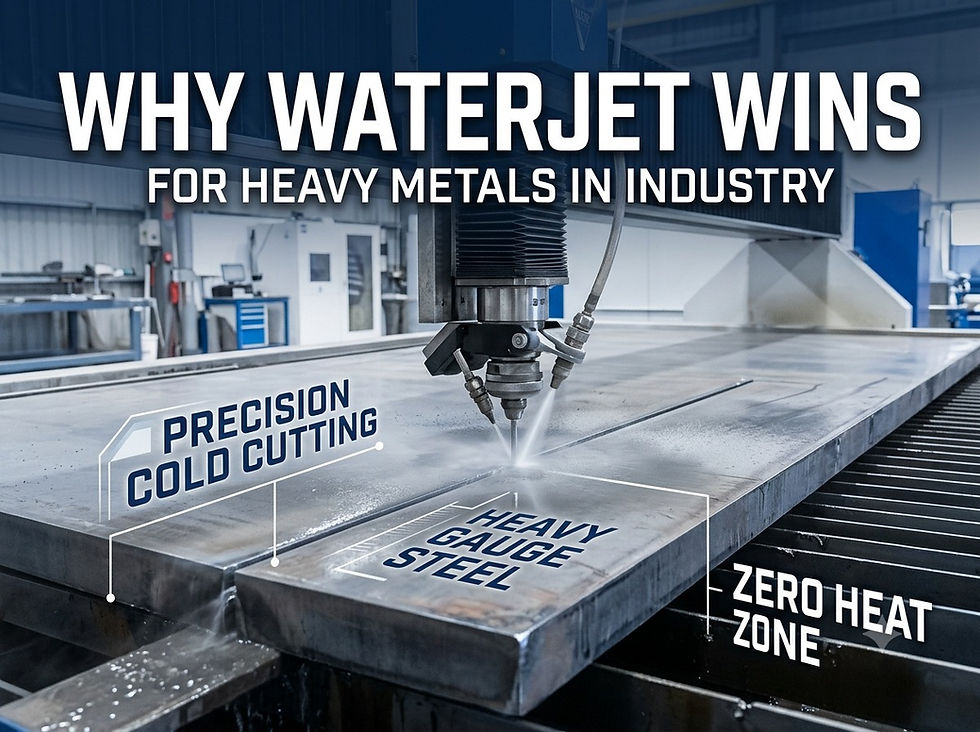
MTM's waterjet cutting service handles metals (steel, aluminium, stainless), stone, tile, glass, composites, foam, rubber, leather, vinyl, and more. Waterjet is a cold-cut process — no heat distortion — ideal for materials that can't tolerate laser heat.
Q: Can I supply my own material for laser or CNC cutting in Sydney?
Yes. MTM can cut your supplied material, use their own stock, or source externally based on your project requirements. Discuss material specs with the team when you send your file for quoting.


Comments